

Visual Environmental Architecture Research Program
The RaW Energy Systems Research Initiative explores the integration of structured visual systems into built environments.
This research program investigates how synchronized visual fields, multi-surface display environments, and continuous visual architectures may function as environmental infrastructure within architectural space.
The Emergence of Visual Environmental Architecture
Architecture has historically incorporated environmental systems that shape human perception within built environments.
Lighting systems regulate illumination.
Acoustic systems shape auditory environments.
Climate systems regulate thermal conditions.
Recent advances in display technology and real-time rendering systems have introduced the possibility of a new environmental layer within architecture: structured visual environments.
Visual Environmental Architecture (VEA) explores how dynamic visual systems may function as continuous environmental infrastructure integrated into architectural space.
Research Domains
Core Framework
Visual Environmental Architecture
Perceptual Science
Perceptual Dynamics of Structured Visual Environments
System Architecture
Structured Visual Systems
Multi-Surface Synchronization Environments
Deployment Models
Residential Visual Environment Deployment
Institutional Environments
Research Architecture Diagram
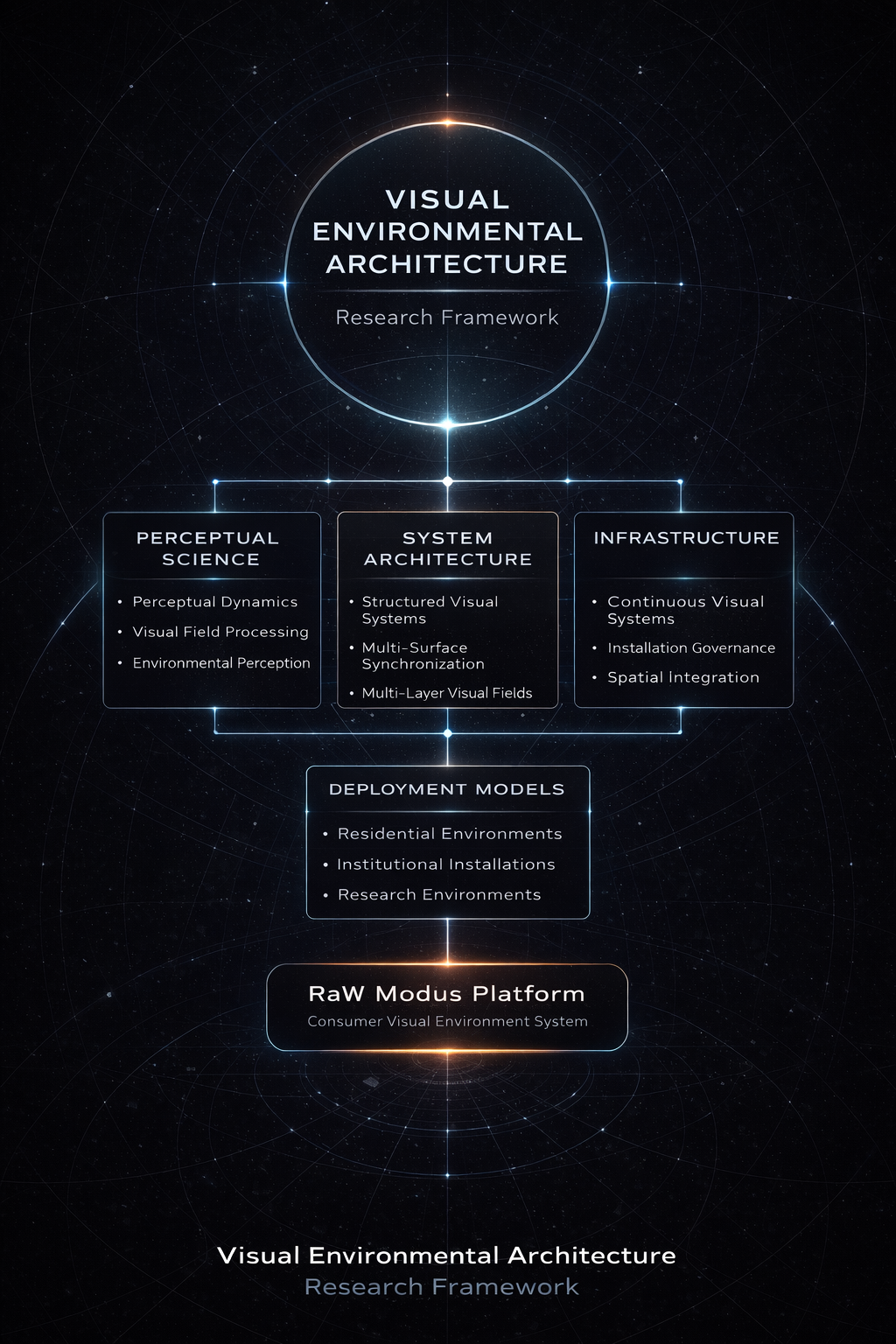
Visual Environmental Architecture Research Framework
The RaW Energy Systems research program explores perceptual science, structured visual systems, and deployment models for continuous visual environments integrated into architecture.
Research Publications
The research program includes multiple papers exploring theoretical foundations, perceptual dynamics, visual system architecture, and deployment models.
View the full research archive in the RaW Energy Systems Research Library.
The RaW Energy Systems Research Initiative examines the development of structured visual systems integrated into architectural environments.
The program explores theoretical models, perceptual science, system architecture, and deployment strategies for continuous visual environments in built space.
The initiative aims to establish a conceptual and technical foundation for visual environmental systems as an emerging dimension of architectural design.