

Multi-Layer Visual Field Architecture
A Framework for Structured Visual Environments and Spatial Perceptual Coherence
Robert Kenneth Nichols, DC
RaW Energy Systems
Author: Robert K. Nichols, DC
Institution: RaW Energy Systems Research Initiative
Category: Multi-Layer Visual Field Architecture
Year: 2026
Abstract
Multi-Layer Visual Field Architecture (MVFA) describes a structured visual environment in which multiple synchronized geometric layers are presented simultaneously across spatially distributed displays. The system organizes visual input through nested temporal and spatial patterns that form a coherent perceptual field surrounding a participant. Unlike traditional media environments that present discrete visual stimuli, MVFA operates as a continuous architectural system composed of synchronized layers of motion, geometry, and spatial anchoring.
The theoretical premise is that structured visual fields may influence perceptual stability, spatial orientation, and attentional coherence by organizing incoming visual information into predictable geometric sequences. The architectural system operates continuously within a dedicated installation chamber where participants are seated or reclined while multi-display geometry sequences operate around them.
This paper presents the theoretical framework, system architecture, operational principles, and proposed research directions for MVFA. The goal is to define a structured approach to immersive visual environments that can be studied within controlled experimental contexts.
1. Introduction
Visual environments influence human perception, orientation, and cognitive engagement. Architectural spaces have long been designed to shape sensory experience through lighting, geometry, and spatial structure. In recent decades, digital display systems have introduced new possibilities for constructing dynamic visual environments capable of surrounding a participant with synchronized visual information.
Multi-Layer Visual Field Architecture (MVFA) expands this concept by organizing visual content into multiple synchronized geometric layers that operate continuously within a defined spatial installation. Rather than presenting individual visual stimuli, MVFA produces a structured perceptual field composed of nested geometric patterns distributed across several displays.
The system functions as a visual architecture rather than a media presentation. Participants do not interact with individual visual elements; instead, they enter an environment in which the visual field itself becomes a structured architectural component.
This framework proposes that structured repetition, synchronized geometry, and spatial anchoring may contribute to perceptual coherence and stable attentional engagement.
2. Background
Human perception is influenced by the organization and predictability of sensory information. Structured environments allow the nervous system to establish expectations about spatial relationships and motion patterns.
Several fields provide context for the MVFA framework:
Environmental psychology demonstrates that spatial organization affects perception and behavior.
Architectural lighting design shows that controlled visual environments influence attention and spatial orientation.
Human–computer interaction research explores how digital visual systems shape perception and cognition.
Immersive display environments such as CAVEs (Cave Automatic Virtual Environments) illustrate how multi-display systems can create continuous visual fields.
MVFA extends these principles by emphasizing layered geometry and continuous operation rather than episodic media presentation.
3. Conceptual Framework
MVFA is based on the premise that structured visual repetition may produce perceptual stability within a spatial environment.
The framework proposes that three components are required:
Layered visual fields
Temporal synchronization
Spatial anchoring
Together these components create a continuous visual architecture surrounding the participant.
3.1 Layered Visual Fields
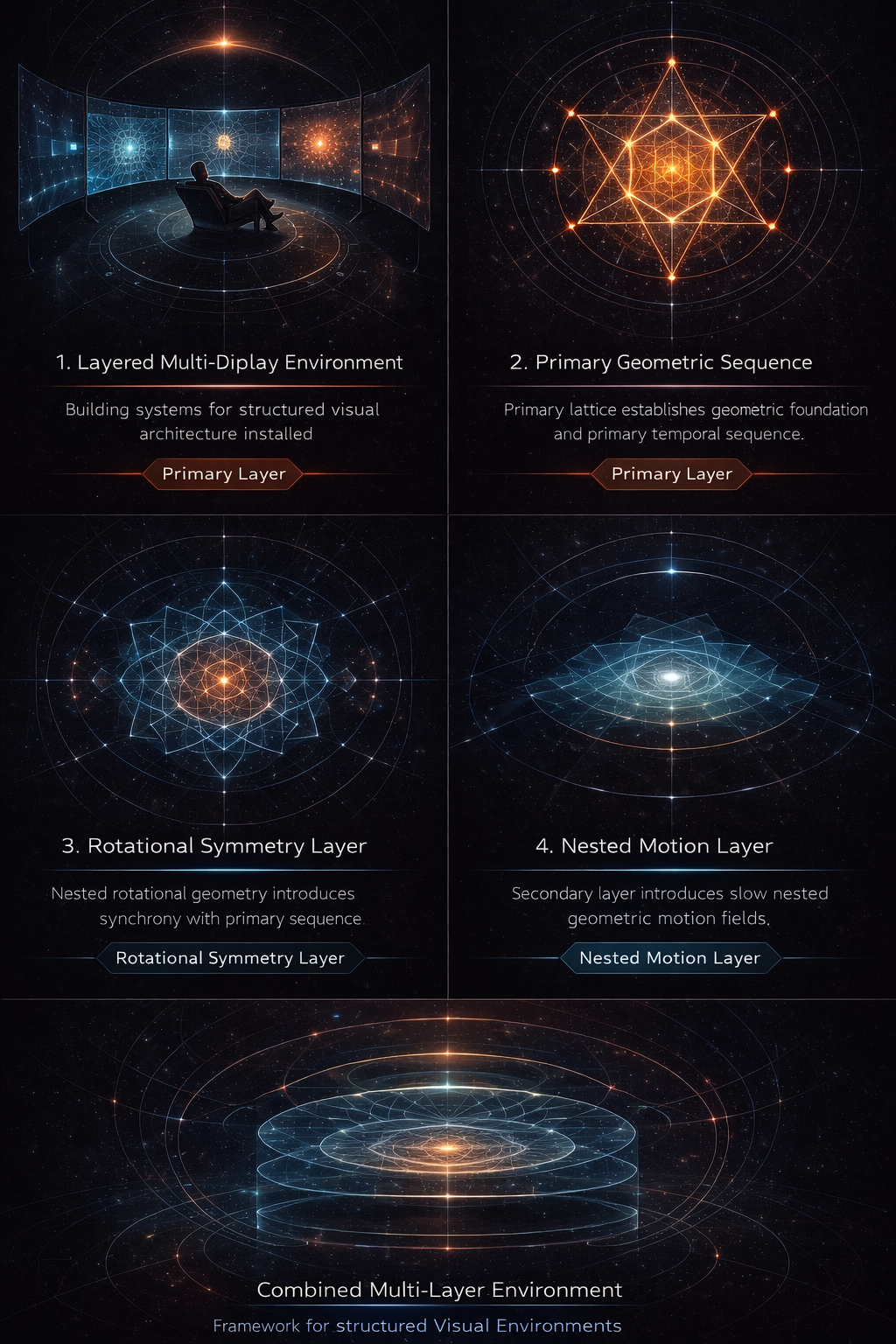
The system organizes visual content into multiple layers operating simultaneously. Each layer contains geometric structures that evolve over time.
Typical layers include:
• primary geometric lattice
• rotational symmetry fields
• nested geometric transformations
• slow background motion fields
These layers operate concurrently while maintaining temporal synchronization.
3.2 Temporal Synchronization
All visual layers share a synchronized temporal framework. Motion patterns and geometric transformations are coordinated across displays.
Synchronization ensures that the environment behaves as a single visual system rather than independent displays.
3.3 Spatial Anchoring
Displays are arranged to surround the participant within a defined chamber. Visual elements extend across displays so that geometry appears spatially continuous.
This arrangement establishes a stable reference frame for visual perception.
4. System Architecture
The MVFA platform typically consists of the following components:
Multi-Display Array
Multiple synchronized displays arranged around a participant.
Visual Rendering System
Software generating layered geometric sequences.
Synchronization Engine
Ensures temporal alignment across displays.
Environmental Control
Lighting and spatial configuration designed to minimize external visual distractions.
Participant Positioning
A central seating or reclining position within the visual field.
5. Operational Principles
The MVFA system operates continuously rather than episodically.
Participants enter the environment while the visual architecture is already functioning.
This operational model reflects several principles:
Continuous Operation
The environment runs continuously rather than starting or stopping for individual sessions.
Structured Repetition
Geometric sequences repeat over time, allowing perceptual familiarity to develop.
Non-Interactive Exposure
Participants observe the environment without direct interaction.
Environmental Stability
Lighting and environmental variables remain consistent to preserve perceptual coherence.
6. Multi-Layer Geometry
Geometric patterns serve as the structural basis of the visual field.
Common geometric forms include:
• radial symmetry patterns
• nested polygons
• fractal lattices
• rotational geometries
• quasicrystal-like arrangements
These structures allow complex visual motion while maintaining predictable relationships.
7. Spatial Deployment
The environment is typically deployed within a dedicated chamber.
The chamber configuration emphasizes:
• symmetric display placement
• minimized external light sources
• controlled seating position
• consistent viewing angles
This configuration allows the participant to remain within a stable visual reference frame.
8. Participant Experience
Participants typically sit or recline within the center of the installation.
Sessions provide structured exposure to the visual architecture for a defined duration.
Common session durations include:
• 30 minutes
• 60 minutes
Repeated sessions may allow participants to develop increased familiarity with the visual system.
9. Research Directions
Several research areas may explore the effects of MVFA environments:
Perceptual Stability
Investigating how structured visual repetition influences spatial orientation.
Attentional Engagement
Studying how layered geometry affects sustained attention.
Environmental Psychology
Evaluating participant responses to continuous architectural visual environments.
Human–Machine Environments
Exploring how synchronized displays alter spatial perception.
10. Limitations
MVFA is a conceptual framework describing a structured visual environment. Empirical research is required to determine how such environments influence perception or cognition.
The system should not be interpreted as a medical or therapeutic intervention.
Future research should employ controlled experimental methodologies to investigate measurable outcomes.
11. Conclusion
Multi-Layer Visual Field Architecture provides a framework for constructing structured visual environments in which synchronized geometric layers form a continuous perceptual field.
Rather than presenting discrete visual stimuli, MVFA operates as an architectural system surrounding a participant with organized visual patterns. By combining layered geometry, temporal synchronization, and spatial anchoring, the system creates a stable visual environment designed for repeated exposure and observational engagement.
Further research is necessary to investigate how such environments influence perception, attention, and spatial orientation.
Related Research
This paper forms part of the Visual Environmental Architecture research framework.
Related papers:
• Visual Environmental Architecture
• Multi-Layer Visual Field Architecture
• Multi-Surface Synchronization Environments
• Continuous Visual Environmental Systems
View full research archive: